Whenever conflict escalates in a strategically important part of the world, the effects are rarely confined to that region alone. They ripple outward through financial markets, energy prices, inflation, currencies, business confidence, and consumer spending. For South African households and investors, the current tensions involving Iran are important not because we need to panic, but because we need to understand how global events can filter into everyday financial life.
At the centre of the concern is oil.
Iran sits within one of the most important energy-producing regions in the world. When there is instability there, markets begin to worry about the possibility of disrupted oil supply, damage to infrastructure, shipping delays, rising insurance costs for transport, or broader escalation across the region. Even before actual shortages occur, the mere possibility of disruption is often enough to push oil prices higher. Markets do not wait for certainty. They price in risk ahead of time.
And because oil is still one of the foundational inputs into the global economy, higher oil prices matter far beyond petrol stations. Oil influences transport costs, logistics, production input costs, food distribution, import prices, airline costs, manufacturing margins, and inflation expectations more broadly. In other words, when oil rises meaningfully, it has the potential to touch almost every layer of the economy.
For clients, that usually raises two main concerns.
The first is: What does this mean for my investment portfolio?
The second is: What does this mean for my monthly budget and cost of living?
Both are valid concerns. But they are not the same concern, and they should not be approached in the same way.
Understanding the current situation
At present, the concern is that conflict involving Iran may deepen, spread, or persist long enough to keep pressure on global energy markets. We do not know exactly how this will unfold. It may de-escalate through diplomacy. It may remain contained but tense. Or it may widen further and result in a more prolonged period of volatility and elevated energy prices.
No one has a crystal ball and can see the future.
What we can say is that markets are trying to assess several questions at once:
Will oil supply be disrupted?
Will key shipping routes remain secure?
Will energy costs remain elevated for weeks, months, or longer?
Will higher energy prices feed through into inflation?
Will central banks become more cautious about cutting interest rates?Will consumers and businesses start pulling back if costs rise too quickly?
These are the kinds of questions that drive short-term volatility. Markets are forward-looking, and when the future becomes less clear, prices often move sharply as investors attempt to reprice risk in real time.
That can feel unsettling, especially when headlines are dramatic. But uncertainty is not the same thing as collapse, and volatility is not the same thing as long-term loss.
1) How this can affect investment portfolios
When geopolitical tension rises, investment portfolios can experience short-term turbulence. This applies not only to direct share portfolios, but also to retirement annuities, unit trusts, tax-free savings accounts, endowments, preservation funds, living annuities, and balanced portfolios. The reason is simple: most long-term savings vehicles ultimately hold market-linked assets such as equities, bonds, property, cash instruments, or offshore exposure, all of which can react to changes in sentiment, inflation expectations, economic outlook, and commodity prices.
In the short term, markets may become more volatile for several reasons.
Firstly, rising oil prices can increase inflation expectations. If inflation looks like it may remain elevated for longer, investors may begin to worry that interest rates will stay higher for longer as well. That can place pressure on asset prices, particularly in sectors or markets that are sensitive to borrowing costs and growth expectations.
Secondly, global uncertainty tends to reduce investor appetite for risk. In times of stress, investors often rotate away from growth assets and toward perceived defensive areas. This can create sharp daily or weekly market moves, even if the long-term implications remain unclear.
Thirdly, higher energy costs can reduce business margins and weaken household spending power. If companies face rising costs while consumers become more cautious, earnings expectations can be revised downward, which can affect equity markets.
All of this can cause investors to feel as though something must be done immediately.
But this is precisely where perspective matters most.
For clients with a long-term investment horizon — especially those investing for five years or more — history has repeatedly shown that markets tend to work through periods of turbulence over time. They do not do so in a straight line, and they do not do so painlessly, but they do tend to adapt. Businesses reprice. Supply chains adjust. policymakers respond. Consumers recalibrate. Investors move from fear to analysis, and from analysis back to opportunity.
This is one of the most important principles in long-term wealth building: temporary market declines and periods of uncertainty are part of investing, not a sign that investing has failed.
That does not mean every event is insignificant. Some geopolitical developments do have lasting effects, especially when they meaningfully alter inflation, trade flows, global growth, or monetary policy. But even then, the correct response is usually not panic. The correct response is thoughtful reassessment.
A good long-term portfolio is not built on the assumption that the world will remain calm. It is built on the assumption that the world will occasionally be volatile, politically unstable, economically uneven, and emotionally difficult. Diversification, time horizon, asset allocation, and disciplined behaviour exist precisely because uncertainty is normal.
That is why, for most long-term investors, the greater risk is often not the geopolitical event itself, but the emotional reaction to it.
Selling out of growth assets after markets have already fallen, stopping long-term contributions in a panic, moving entirely into cash during a volatile spell, or making sweeping portfolio changes based on headlines can permanently damage a financial plan. In many cases, investors who react emotionally convert temporary volatility into permanent financial harm.
This is especially relevant for retirement savings such as RAs, preservation funds, pension assets, long-term unit trust investments, TFSAs, and endowments. These are typically not vehicles designed around short-term news cycles. They are built for long-term outcomes. Their purpose is not to avoid all volatility, but to participate in long-term growth despite volatility.
So while it is understandable for clients to feel anxious when markets wobble, it is crucial to distinguish between being uncomfortable and being off course. Those are not always the same thing.
2) How this can affect your budget and cost of living
While portfolios often recover with time, the impact on monthly living costs can feel much more immediate.
And for many households, that is where the real pressure lies.
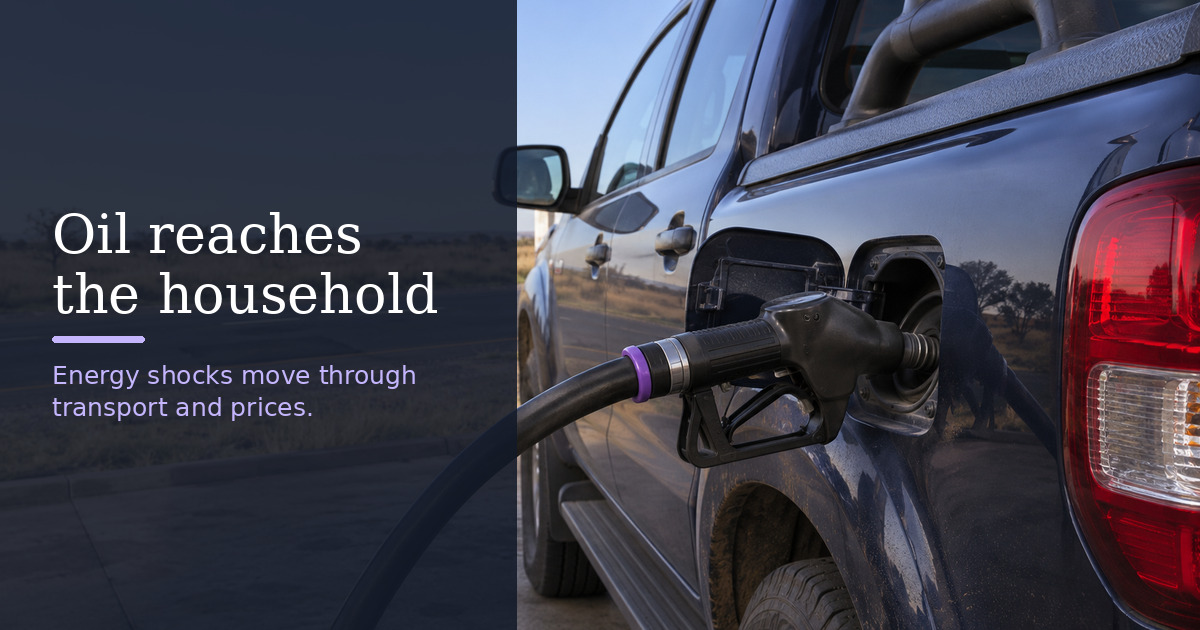
South African consumers are highly exposed to changes in fuel prices. When global oil prices rise, and especially when that is combined with rand weakness or broader inflationary pressure, households can feel the effect quickly. Fuel becomes more expensive. Transport becomes more expensive. Delivery costs rise. Food prices can come under pressure. Imported goods may become more costly. Businesses facing higher input and distribution costs may pass some of that burden on to consumers.
For clients already dealing with a tight budget, this is not theoretical. It matters in a very practical way.
A higher fuel bill may not only affect the cost of commuting. It can affect school transport, grocery runs, service provider costs, courier fees, domestic travel, small-business operating expenses, and even municipal or lifestyle spending patterns over time. And once rising transport or energy costs begin filtering through the broader economy, the impact can be felt across many categories of household expenditure.
This is why periods like this can feel doubly stressful.
Clients may see short-term fluctuations in their investments at the same time that their real-world cost of living starts increasing. In other words, the investment statement may look more volatile at exactly the same moment that cash flow becomes tighter.
That combination can create emotional pressure. And emotional pressure often leads to rushed decisions.
This is why it is so important to separate the issues clearly.
Your long-term portfolio may need patience.
Your short-term budget may need adjustment.
But neither should be handled from a place of fear.
The long-term investment outlook: why perspective matters
One of the most reassuring truths in investing is that markets have lived through an extraordinary range of crises before: wars, terrorist attacks, oil shocks, banking failures, pandemics, elections, sovereign debt scares, inflation surges, recessions, and political upheaval. None of that means market losses are pleasant, but it does remind us that markets are remarkably adaptive over time.
Over a five-year-plus investment horizon, a well-diversified portfolio has historically had a far greater chance of rewarding patience than rewarding panic.
That is because markets are not static. They absorb new information continuously. They reprice quickly. Often, the sharpest falls happen at the height of uncertainty, while recoveries begin before the news flow feels reassuring. This is why trying to “time” exits and re-entries around geopolitical stress is so difficult. By the time an investor feels emotionally comfortable again, a large part of the recovery may already have occurred.
This is not to say that every client should simply ignore events. Rather, clients should interpret events properly.
A sudden geopolitical shock may justify a review, but not necessarily a reaction.
It may justify a conversation, but not necessarily a switch.
It may justify caution, but not fear.
That distinction is vital.
Long-term investment strategy should be led by financial planning principles: time horizon, risk tolerance, liquidity requirements, income needs, tax efficiency, diversification, and long-term goals. It should not be led by whichever headline happens to be dominating the news that week.
The near-term household outlook: where the pressure may be more real
Ironically, while investors often focus first on the market implications, the more immediate financial challenge may be the pressure on the household budget.
This is because rising prices affect behaviour right away. A more expensive fuel tank, higher transport costs, more costly essentials, and tighter monthly affordability can change how clients feel from one month to the next. And when clients feel financially squeezed, their tolerance for investment volatility often drops too.
That is perfectly human.
When times are difficult and budgets are already constrained, any additional pressure is naturally a concern. A possible fuel or inflation shock is not something to dismiss. It deserves attention. But the most productive response is usually not dramatic action. It is targeted action.
In times like this, financial resilience often comes from small, sensible decisions made consistently, not from one large emotional move.
Practical ways clients can soften the impact on their budget
If energy costs remain elevated and household expenses come under pressure, there are several practical, measured steps clients could consider.
Drive less where possible. Combine errands, reduce unnecessary trips, plan routes more intelligently, and avoid fragmented travel that wastes fuel.
Use ride-sharing or lift clubs where practical. Sharing commuting costs with a colleague, neighbour, or family member can meaningfully reduce transport pressure over time.
Work from home when possible. Even one or two fewer commuting days per week can make a noticeable difference to fuel spend over a month.
Review driving habits. Smooth driving, correct tyre pressure, proper vehicle maintenance, reduced idling, and avoiding unnecessary weight in the car can improve fuel efficiency.
Revisit discretionary spending before essentials are affected. It is often easier to trim non-essential subscriptions, leisure spending, convenience purchases, and impulse expenditures early rather than waiting for cash flow stress to become severe.
Plan grocery shopping more deliberately. Shop with a list, reduce unnecessary store visits, compare staple prices, and be more intentional about convenience spending.
Review household cash flow honestly. Understand what your “must-pay”, “should-pay”, and “could-delay” categories are. A budget under pressure needs clarity more than complexity.
Strengthen a short-term emergency buffer where possible. Even a modest contingency amount set aside for fuel, food, or transport volatility can help reduce the sense of instability.
Be cautious with debt. When budgets tighten, high-interest debt becomes even more dangerous. Avoid solving an inflation problem with an expensive credit problem.
Speak to your adviser before reducing or stopping investments. Sometimes contribution changes may be necessary, but they should be assessed carefully and strategically, not emotionally. There may be better ways to create room in the budget without compromising long-term goals unnecessarily.
These are not panic measures. They are stabilisation measures.
They are the kinds of adjustments that help households absorb pressure without causing lasting damage to long-term financial plans.
What clients should not do
Just as important as what to do is what not to do.
Clients should avoid making major portfolio decisions based purely on fear.
They should avoid assuming that short-term market falls mean their long-term plan has failed.
They should avoid abandoning growth assets simply because headlines are uncomfortable.
They should avoid cancelling savings plans or long-term structures without first understanding the long-term cost of doing so.
They should avoid overreacting to scenarios that are still uncertain and still evolving.
Fear narrows judgement. It makes every risk feel immediate and every decision feel urgent. But most good financial decisions are not made in urgency. They are made in clarity.
Where this may go from here
There are several possible paths from here.
The most constructive outcome would be de-escalation. If tensions cool, supply fears ease, and market confidence begins to stabilise, oil prices may settle and a significant portion of the immediate anxiety could fade.
A more difficult outcome would be a prolonged period of contained tension. In that case, markets may remain choppy, energy prices may stay elevated for longer, and household budgets may remain under pressure even without a broader crisis.
A more severe outcome would be wider regional disruption, more persistent supply concerns, and a deeper inflationary effect on the global economy. That would likely place more strain on both markets and consumers.
At this stage, certainty is not available. Prudence is.
And prudence does not mean assuming the worst. It means preparing thoughtfully, remaining informed, and resisting reactive decision-making.
The Navigate Wealth view
At Navigate Wealth, our view is that clients should approach the current situation with calm, perspective, and discipline.
For long-term investors, the key message is reassuring: markets have weathered many storms before, and well-structured portfolios are designed with turbulence in mind. If your investment horizon is five years or longer, short-term volatility, while unpleasant, does not automatically justify a change in strategy.
For households, the more immediate issue may be budget pressure. Higher fuel and transport costs, and the knock-on effect on goods and services, can place genuine strain on monthly affordability. That deserves attention and practical adjustment. But even here, the best response is not panic. It is careful prioritisation and measured action.
If you are concerned about how current global events may affect your investments, your affordability, or your broader financial plan, please contact Navigate Wealth. We are here to help you assess your situation carefully and make sound decisions from a place of clarity rather than anxiety.
Because in uncertain times, the goal is not to react the fastest.
It is to respond the wisest.