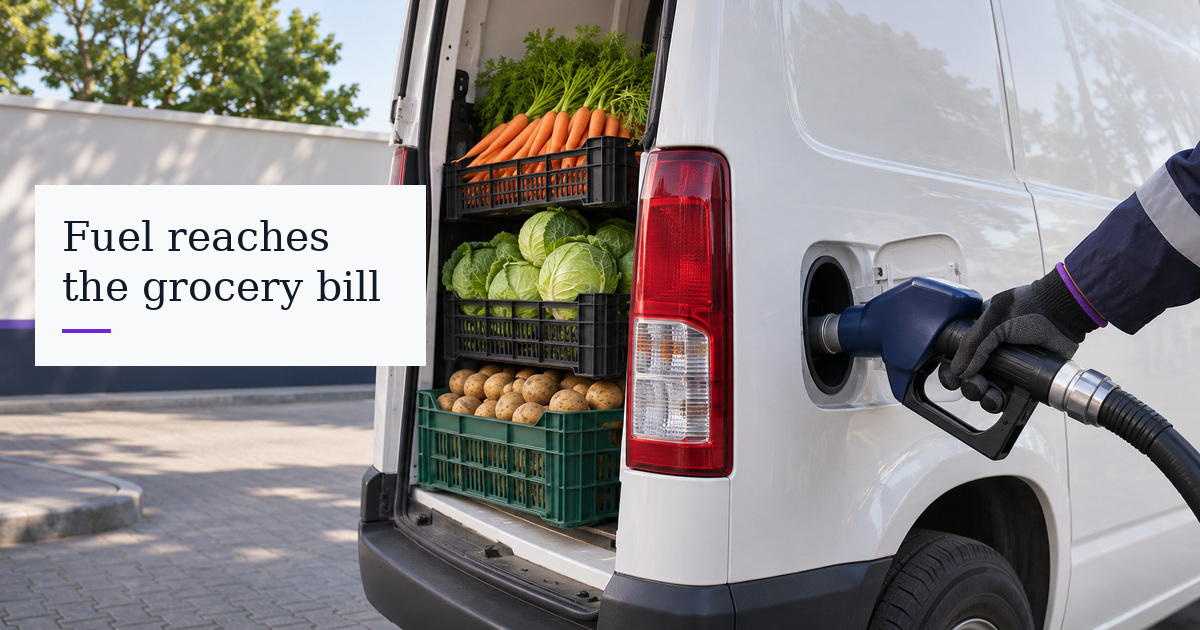
South African motorists absorbed a steep increase at the pumps on 2 September. On current indications, October will be steeper still, and this time it would take the petrol price past its previous record.
The September adjustment announced by the Department of Mineral and Petroleum Resources added 129.00 cents a litre to both grades of petrol. Diesel moved far more sharply: 293.90 cents a litre for 0.05% sulphur and 314.90 cents for 0.005%. Illuminating paraffin rose 213.00 cents a litre at wholesale, which matters in households that do not own a car at all.
The department attributed most of the move to international factors. The average Brent crude price used in the calculation rose from US$82.37 to US$87.85 a barrel over the pricing period, and refined product prices rose further on constrained global supply. A firmer rand, which moved from R16.46 to R16.26 against the dollar, took roughly 21 cents a litre off petrol and 29 cents off diesel. A slate levy of 83.28 cents a litre, itself 21.90 cents higher than the month before, worked in the other direction.
Why October looks larger
Brent has continued to climb since that pricing period closed, trading above US$100 a barrel through the first half of September. South African fuel prices are set monthly on a rolling average of daily international product prices and the rand-dollar exchange rate, so a sustained move of that size in the middle of one month shows up in the next month's price. Daily under-recovery data compiled through the Central Energy Fund pointed, at mid-September, to a further increase of roughly R2 a litre on petrol and between R1.70 and R2.05 a litre on diesel.
Two cautions matter. First, these are month-to-date figures, not a decision. The pricing period runs to the end of September and the Minister's announcement is what sets the price. A sharp reversal in crude, or a stronger rand in the closing days, would change the number. Second, the direction of travel is nonetheless clear. An increase of that size would lift inland 95 unleaded above R29 a litre and take 50ppm diesel past the record set in May. The next adjustment takes effect on Wednesday 7 October.
What this costs an actual household
Abstract cents-per-litre figures are easy to shrug off, so it helps to convert them.
A household running one car 1 500 km a month at 9 litres per 100 km uses about 135 litres. September's 129 cents already added roughly R174 a month. Another R2 a litre in October would add a further R270, taking the combined increase to about R444 a month, or a little over R5 300 a year, against where the household sat in August. On a 50-litre fill, the two months together add roughly R165 per tank.
For a small business the arithmetic is harsher, because diesel has moved further. A bakkie covering 3 000 km a month at 11 litres per 100 km uses about 330 litres. September's 314.90 cents added roughly R1 039 a month. A further R2.05 would add about R677, for a combined increase near R1 716 a month on a single vehicle. Owners running several vehicles on thin margins should be reworking their delivery pricing now rather than in November.
The second hit, which arrives later
Fuel does not stay in the fuel line of a budget. It moves through freight, food, public transport fares and the cost of almost every delivered good, usually with a lag of one to three months. That is where the second effect on your household sits, and it is the one most people fail to plan for.
It is also what the Reserve Bank is watching. At its July meeting the Monetary Policy Committee held the repurchase rate at 7.00%, but the decision was not unanimous: four members favoured holding and two preferred an increase of 25 basis points. The Committee said it expected headline inflation to remain above 4% until early next year, driven mainly by fuel rather than by underlying demand. South Africa's inflation objective is now 3%, with a tolerance band of one percentage point either side. The next rate announcement is due on 23 September.
We are not going to predict that decision, and nor should anyone else. The useful point for planning is narrower: the balance of risk has shifted away from rate cuts, and any household budget built on the assumption that debt costs will fall over the next year is built on an assumption the data no longer supports.
What we would suggest doing now
Rework the transport line of your budget using the October projection rather than the August figure, and check what that does to the month rather than the year. A R450 monthly gap is usually absorbed quietly by a credit card, which is the most expensive way to absorb it.
If you carry variable-rate debt, model a repayment at one percentage point higher than today's rate. If that number is uncomfortable, deal with it while you still have choices.
Resist the instinct to solve a cash-flow squeeze with a retirement savings withdrawal. A withdrawal is taxed at your marginal rate, permanently reduces the capital that would have compounded to retirement, and rarely closes a recurring monthly gap.
Business owners who quote on fixed-price contracts should look at their fuel assumptions before signing anything long-dated, and consider whether a fuel escalation clause is appropriate.
Finally, treat this as a reason to review, not to react. Selling growth assets or abandoning a long-term plan because of a fuel shock is how a temporary cost problem becomes a permanent capital problem.
If you would like help reworking your household budget or stress-testing your debt repayments against a higher rate environment, please speak to the Navigate Wealth team.