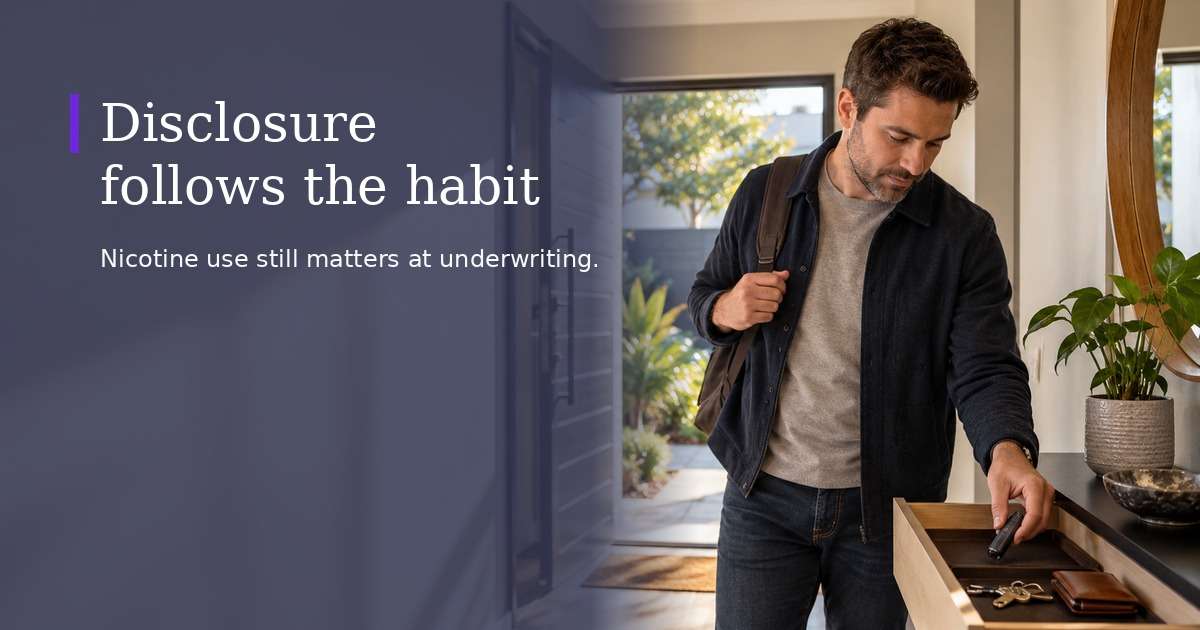
A client who gave up cigarettes and took up vaping has, in their own mind, stopped smoking. Their insurer almost certainly disagrees. South African life insurers generally classify any nicotine user as a smoker for underwriting purposes, including users of electronic delivery systems. BrightRock states the position plainly on its own website: most insurers here charge users of e-cigarettes the same rates they charge smokers.
This is not a technicality. It sits where two things meet: what you told the insurer when the policy was written, and what it may do if that was wrong.
Why the change in habit matters legally
Section 59 of the Long-term Insurance Act 52 of 1998 deals with misrepresentation and failure to disclose material information. The test for materiality is set out in section 59(1)(b), and it is worth reading in the Act's own words: information is material if "a reasonable, prudent person would consider that the particular information constituting the representation or which was not disclosed, as the case may be, should have been correctly disclosed to the insurer so that the insurer could form its own view as to the effect of such information on the assessment of the relevant risk".
Nicotine use meets that test comfortably. It sits on almost every underwriting questionnaire precisely because it changes the price of the risk.
The second point is one South Africans often assume works differently from how it does. There is no statutory period after which a South African life policy becomes incontestable. Unlike some jurisdictions, our legislation gives an insurer no deadline after which it loses the right to investigate the original disclosure. A claim made many years after inception can still be assessed against what was disclosed at the outset.
What an insurer must do before it repudiates
This cuts both ways. The Policyholder Protection Rules made under section 62 of the Act require an insurer that rejects or disputes a claim to give the claimant reasons in sufficient detail to dispute them, details of the relevant ombud and the applicable time limits, and not less than 90 days to make representations.
Where a dispute is not resolved, the Life Insurance Division of the National Financial Ombud Scheme South Africa considers complaints at no cost to the consumer. In 2025 it handled 5 020 complaints and recovered just under R300 million.
The regulatory backdrop is moving
Parliament is working through the Tobacco Products and Electronic Delivery Systems Control Bill [B33-2022]. Introduced in December 2022, it lapsed at the end of the sixth Parliament and was revived in the seventh. The Portfolio Committee on Health adopted the motion of desirability on 24 June 2026 and began clause-by-clause deliberations on 12 August 2026. It has not passed the National Assembly, so nothing in it is law yet.
As introduced, the Bill brings tobacco products and electronic delivery systems under a common set of controls, though not identical ones, and the committee has said it intends to differentiate between combustible and non-combustible products. The direction of travel is toward treating vaping as a regulated nicotine product, which is where insurers already are.
What we suggest clients do
If your nicotine use has changed in either direction since your cover was underwritten, deal with it deliberately.
- If you have started vaping or using any nicotine product since your policy was issued, tell your insurer, and read the wording on your continuing duty of disclosure, because it varies. A voluntary disclosure is an underwriting conversation; the same fact found at claim stage is a dispute.
- If you have been completely free of nicotine, in any form, for 12 months or more, you can apply to be reassessed at non-smoker rates. This is an application, not an automatic reclassification, and usually requires evidence. On substantial cover the saving can be meaningful.
- If you are arranging new cover, answer the nicotine question about every form of it, not only cigarettes.
The cost of getting this wrong is not paid by the person who filled in the form, but by whoever claims. If you would like us to review how your cover was underwritten and whether a reassessment is worth pursuing, please speak to the Navigate Wealth team.
Sources and further reading
- Tobacco Products and Electronic Delivery Systems Control Bill [B33-2022]
- Parliament of South Africa, Portfolio Committee on Health media statement (12 August 2026)
- Policyholder Protection Rules (Long-term Insurance), 2017
- National Financial Ombud Scheme South Africa
- BrightRock, E-cigarettes and your life insurance policy