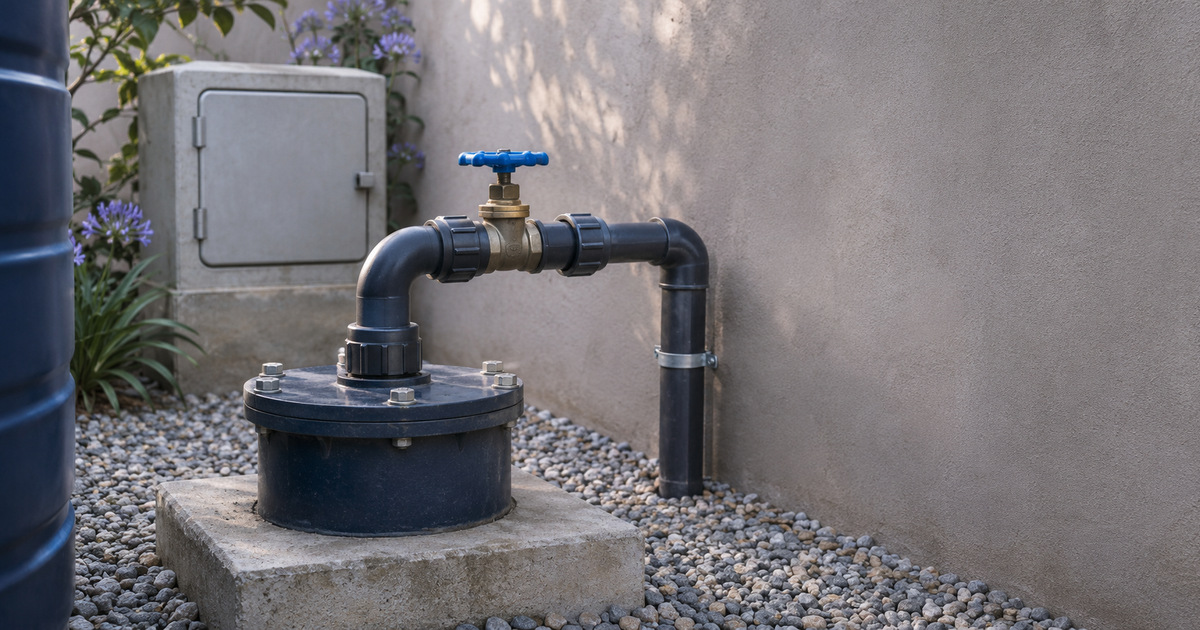
Over the past few years a great many South African households spent real money to become less dependent on their municipality. Solar panels and batteries went up on roofs; boreholes went down in gardens. The logic was straightforward: if the supply is unreliable, buy your own.
A growing number of municipalities have now introduced a monthly charge that applies precisely because a household made that investment. It is a small line on a municipal account, and it quietly changes the arithmetic that justified the spending in the first place.
What the charges look like
They take two broad forms. The first is a service fee attached to a borehole. In Mbombela, the approved tariff schedule levies R406.50 a month for a residential borehole and R877.12 for a business one, and a property with several boreholes can be charged for each. Mangaung applies a R70 monthly borehole service fee to properties without a municipal water meter. Abaqulusi applies R133 a month.
The second attaches to electricity. Thaba Chweu has introduced a monthly levy of R582.64 where a network is available to a property but the property is not drawing from it, together with a basic fee of R321.11 and a monthly access charge of R10.92 for customers with their own small-scale generation. Those charges took effect in July 2026.
These are not informal additions. The National Energy Regulator of South Africa completed its consideration of electricity distributors tariff applications for the 2026/27 financial year in mid-2026, approving tariffs for all 176 licensed distributors with effect from 1 July 2026. Municipal tariff schedules are published annually and are a matter of public record.
Not every such charge is accepted as lawful. AfriForum has questioned whether a levy on a property that is not connected can stand without a cost-of-supply study and the required approvals, and has argued that a fixed sewerage charge should not apply unchanged where the water never reaches the sewer. Those are contested positions rather than settled law. A household should budget for the charge as it currently stands.
Why municipalities charge it
The municipal argument is not unreasonable. A distribution network costs much the same to maintain whether a household draws a great deal of electricity through it or almost none. When enough customers reduce their consumption, the fixed cost of the network does not fall with them; it is recovered from fewer units. A household with panels on the roof that still leans on the grid at night, or through a cloudy week, is using the network as backup. Fixed charges are how that cost is recovered.
Understanding the logic does not change the effect on a household budget, which is the part that concerns us here.
What it does to the payback calculation
Consider a solar and battery installation costing R180 000 that reduces an electricity account by R1 400 a month. On those numbers it pays for itself in a little under eleven years. Add a R582.64 monthly network availability levy and the net saving falls to roughly R817 a month, which pushes the payback beyond eighteen years. Most installations will need an inverter or a battery replacement well inside that period.
A borehole charge of R406.50 a month is R4 878 a year. It is worth being clear about what kind of cost that is. A fixed charge cannot be managed down by using less. Unlike a water or electricity account, no change in behaviour reduces it.
What this means for South Africans
Three points follow, whether a household is weighing up an off-grid or borehole investment or living with one already.
- Model the fixed charge into the decision, and escalate it at least at inflation. A levy introduced at R582.64 is unlikely to stay there.
- Fixed charges fall hardest on fixed incomes. A retiree who reduced consumption deliberately cannot reduce a levy, and it consumes a larger share of a pension than of a salary.
- Check your own municipality schedule rather than assuming. These charges vary enormously between municipalities, are set annually, and generally take effect on 1 July.
Where an installation is already in place and a new levy has appeared, the question is no longer whether to proceed. It is whether the household budget still reflects reality. That is a smaller question, and an easier one to put right.
If you would like to review how fixed municipal charges and energy or water investments sit within your household budget and your longer-term plan, please speak to the Navigate Wealth team.