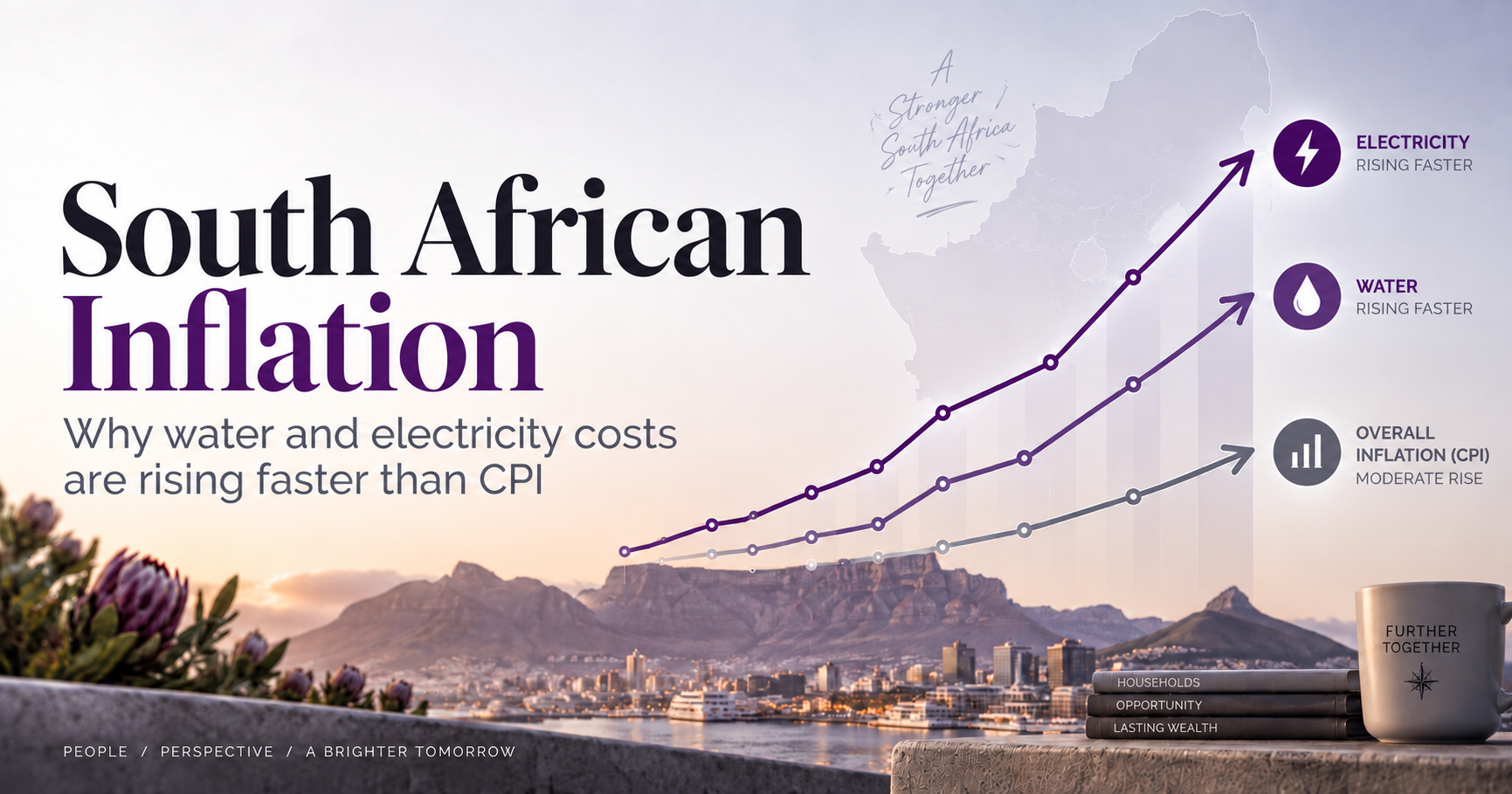
The Competition Commission released the third edition of its Cost of Living Report on 4 September 2026. Its central finding will not surprise anyone who pays a municipal account: the prices that dominate a household budget have been rising considerably faster than the inflation rate quoted in the news.
The size of the gap
Since January 2020, the Commission reports that electricity prices have risen 100.5% and water by roughly 85%. Over the same period, consumer prices in general rose about 36%. Electricity has, in other words, roughly doubled while the general price level rose by about a third.
The pattern continues in the most recent year. Between July 2025 and July 2026, headline inflation was 4.3%, while electricity rose 8.1% and water 10.1%. Petrol climbed 26% in the first half of 2026 and minibus taxi fares followed, up 13%. School fees have moved on their own track too: the Commission records primary school fees up 46% and high school fees up 51% since 2020.
The burden is not evenly shared. For the lowest-income households, food and non-alcoholic beverages absorb about 40.7% of spending and housing and utilities a further 26.1%. When electricity rises at twice the rate of inflation, those households feel it immediately and have little room to absorb it. Government has approved raising the free basic electricity allocation from 50kWh a month towards a range of 200 to 300kWh, which will help at the lowest end of the income scale.
Why this matters for financial planning
Headline inflation is an average across a basket that includes items many households rarely buy. Your own rate depends on what you actually spend money on. A retired couple with a paid-off home, a medical scheme contribution, a municipal account and a car spends a very different basket from a family of four with two children in school.
The practical problem is that plans are often escalated at the average. Consider a household spending R30 000 a month, of which R2 500 goes to electricity and water. If the overall budget is escalated at 4.3% and utilities keep rising at 9%, then after five years the budget is about R37 000 while the utility bill alone is about R3 850. The utility share of spending rises from 8.3% to 10.4%, and every extra rand has to come out of something else. Over a twenty-year retirement, that quiet reallocation is not a rounding error.
What we would do about it
Three adjustments do most of the work.
Escalate the plan by category rather than by a single average. Municipal costs, medical scheme contributions and school fees each deserve their own assumption, and each has historically run ahead of headline inflation.
Treat education as a separate goal with its own funding, rather than as a line in the monthly budget. Fees rising at 8% to 9% a year cannot be funded from an income rising at 4%.
Reduce exposure where you can. Solar, a heat pump, or a water tank are, in planning terms, a way of pre-paying a future utility bill at today's price. Whether that is worthwhile depends on the payback period against your own consumption, which is worth calculating rather than assuming.
None of this argues for pessimism. It argues for using the right numbers. A plan built on 4.3% for everything will look comfortable on paper and tight in practice.
If you would like us to review the inflation assumptions in your own retirement or education plan, please speak to the Navigate Wealth team.